Futurescape Personality Quiz: Results, RIASEC Types & Career Guide
The Futurescape Personality Quiz is a career-interest exploration tool associated with American Student Assistance (ASA). It was designed to help young people explore education and career possibilities based on their interests, strengths, passions, and goals. ASA described Futurescape as a personalized digital platform for exploring real-world careers beyond the classroom.
If you are searching for the Futurescape Personality Quiz, you may also be wondering what the results mean, how RIASEC works, what a Holland Code is, and which careers may fit different interest types.
This guide explains all of these points in one place.
Important: Futurescape’s features and availability can change over time. Before taking the quiz, check the current official platform rather than relying on an old question count or outdated instructions.
Key Takeaways
- Futurescape is a RIASEC-based career-interest quiz, not a full personality test.
- Your result is a starting point for career research, not a final career decision.
- Your top three interest areas can form a Holland Code, which gives more detail than a single personality label.
- The six RIASEC areas are Realistic, Investigative, Artistic, Social, Enterprising, and Conventional.
- Career, salary, and education information may be particularly useful for U.S. users, but international readers should verify local information separately.
- Always verify the current features, question count, and availability on the official platform before taking the quiz.
What Is the Futurescape Personality Quiz?

The Futurescape Personality Quiz is better described as a career-interest assessment and exploration experience rather than a conventional personality test.
Futurescape was created by American Student Assistance (ASA), a U.S. nonprofit focused on helping young people explore education-to-career pathways. ASA described the platform as a mobile-first experience that allowed students to explore thousands of education and career paths.
The idea behind Futurescape is straightforward:
Understand what interests you → discover possible career directions → research those careers → make better-informed education and career decisions.
That makes it particularly relevant to students who are unsure about what they want to study or what type of work might suit them.
Is Futurescape a Personality Test or Career Quiz?
It is closer to a career-interest quiz than a complete personality test.
A full personality assessment may examine broad personality traits, behavior patterns, or psychological characteristics. A career-interest assessment instead focuses on the types of activities, subjects, environments, and work that you may find interesting.
Futurescape’s career-exploration approach has been associated with the RIASEC/Holland interest framework, which divides career interests into six broad categories.
Those six categories are:
- Realistic
- Investigative
- Artistic
- Social
- Enterprising
- Conventional
The same six interest areas are used by the U.S. Department of Labor’s O*NET Interest Profiler.
How to Take the Futurescape Quiz: Step by Step
Because online platforms can change, the exact screens and process may not always remain the same. Use these steps as a general guide and verify the current official platform before starting.
Step 1: Open the official Futurescape platform
Look for the current official Futurescape experience and confirm that the quiz or career-exploration feature is currently available.
Do not rely on an old third-party link if it redirects somewhere unexpected.
Step 2: Take the quiz without overthinking
Find a quiet place and answer naturally.
Your goal is to describe what you actually enjoy—not what you think you should enjoy.
Step 3: Choose interests rather than status
If you enjoy repairing machines, choose practical activities.
If you love research and science, choose analytical activities.
If you enjoy helping people, teaching, or communicating, choose people-focused activities.
Do not select an answer simply because the related career has a high salary.
Step 4: Review your result
Look at your strongest interest areas.
Try to identify your top three RIASEC categories if the current version provides them.
Step 5: Record your result
Save, screenshot, or write down your result if the platform allows it.
This makes it easier to compare the result with other career assessments later.
Step 6: Research the suggested careers
Don’t stop when the quiz gives you career suggestions.
Choose several careers and investigate:
- Required education
- Skills
- Typical work environment
- Salary
- Job outlook
- Training requirements
- Work-life expectations
- Local employment opportunities
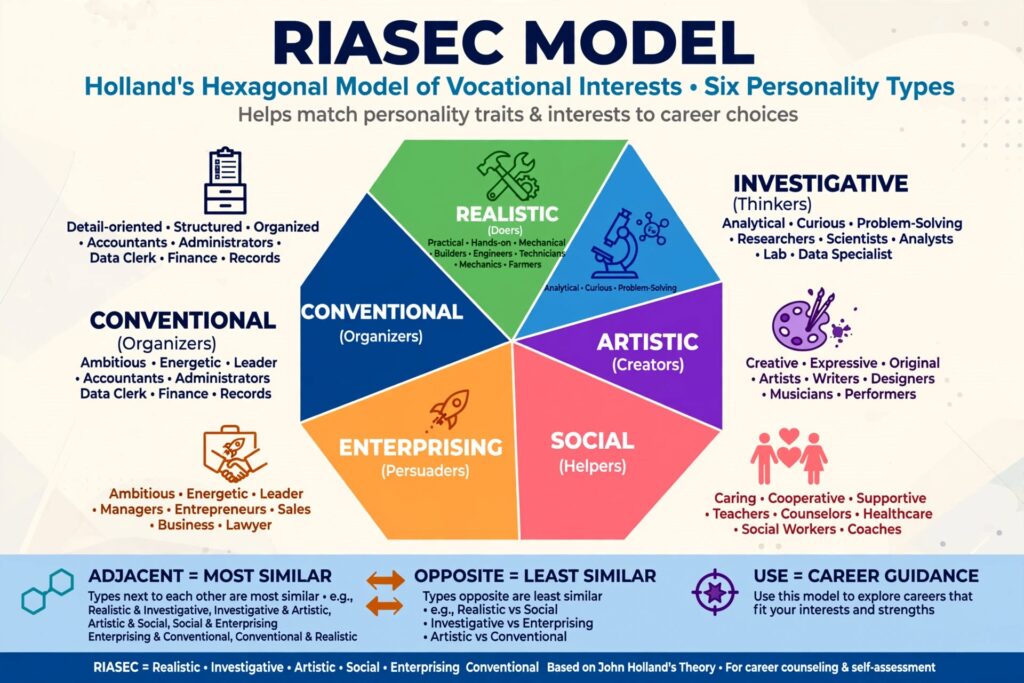
What Is RIASEC?
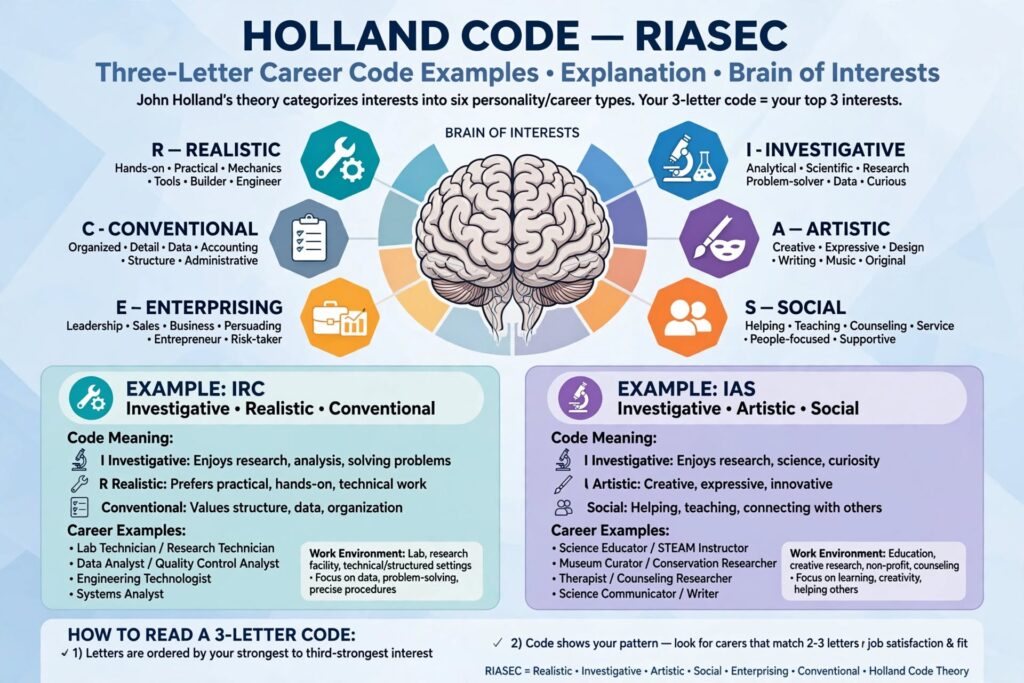
RIASEC is a widely used framework for understanding career interests.
The name comes from the first letters of six interest categories:
| Letter | Type |
|---|---|
| R | Realistic |
| I | Investigative |
| A | Artistic |
| S | Social |
| E | Enterprising |
| C | Conventional |
O*NET’s Interest Profiler currently measures these six occupational interest areas and is explicitly compatible with Holland’s R-I-A-S-E-C interest structure.
Most people are not simply one type.
You may enjoy science and practical work. You may enjoy creativity and business. You may enjoy helping people and analyzing information.
That is why looking at several interest areas together can be more useful than focusing on one label.
What Is a Holland Code?
Your Holland Code is a short code representing your strongest RIASEC interest areas.
For example:
IRC
could mean:
- I — Investigative: your strongest interest
- R — Realistic: your second strongest interest
- C — Conventional: your third strongest interest
The first letter represents your strongest area, while the second and third letters provide additional information about the type of work you may prefer.
This is important because two people can both have I as their first letter but have very different second and third letters.
For example:
IRC and IAS
may both start with Investigative interests, but their combinations point toward different kinds of career environments and activities.
O*NET occupational profiles also use high-point RIASEC codes to represent the first, second, and third highest interest areas for occupations.
Why Is the Three-Letter Code Useful?
A single label such as “Investigative” can be too broad.
A three-letter code gives you more context.
Instead of asking:
“Am I an Investigative person?”
you can ask:
“What careers fit my Investigative + Realistic + Conventional combination?”
That creates a much more useful career-search starting point.
The Six RIASEC Career Types at a Glance
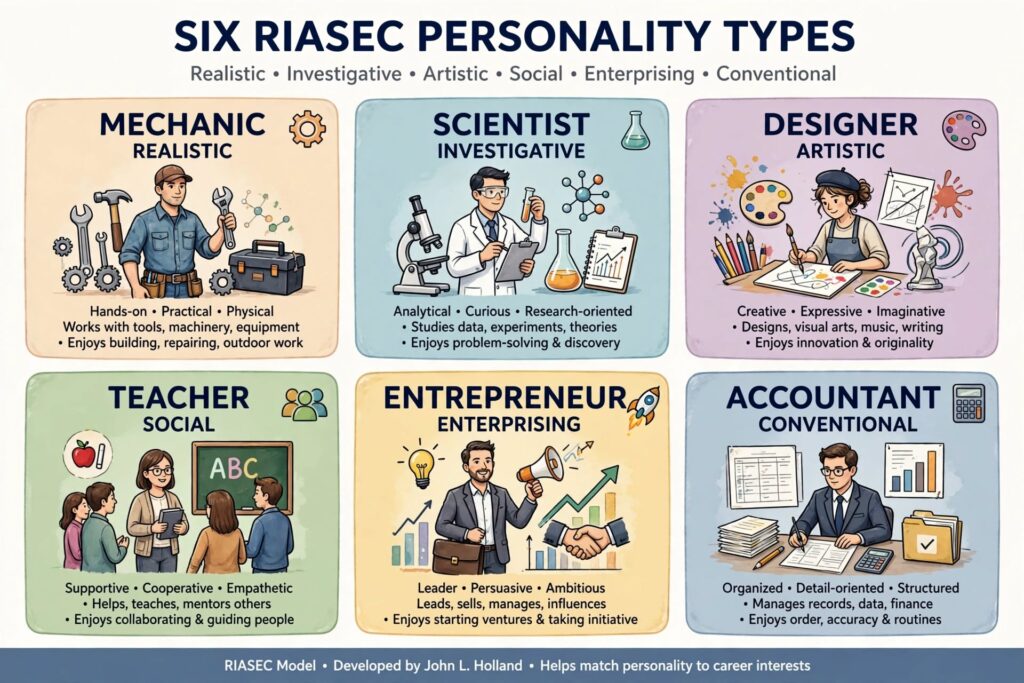
| Type | Core Interest | Favourite School Subjects | Example Careers | Typical Work Environment |
|---|---|---|---|---|
| Realistic | Hands-on, practical work | Technical studies, physics, PE | Mechanic, electrician, engineer | Workshops, outdoors, construction sites |
| Investigative | Research and analysis | Science, maths, computing | Data analyst, researcher, doctor | Labs, offices, hospitals |
| Artistic | Creativity and expression | Art, literature, media | Graphic designer, animator, writer | Studios, creative spaces |
| Social | Helping and teaching | Languages, psychology, social studies | Teacher, counselor, nurse | Schools, clinics, communities |
| Enterprising | Leading and persuading | Business, economics, debate | Entrepreneur, marketer, sales manager | Fast-paced, goal-driven teams |
| Conventional | Order and accuracy | Maths, accounting, IT | Accountant, banker, administrator | Structured offices |
These categories describe broad interests rather than strict career rules. For example, an engineer may have Realistic and Investigative interests, while a product designer may combine Artistic and Enterprising interests.
CareerOneStop, another U.S. Department of Labor resource, describes these same six groups in terms of preferred activities and work environments.
1. Realistic Personality Type
Realistic interests are generally associated with hands-on, practical and physical activities.
You may enjoy:
- Working with tools
- Building things
- Repairing equipment
- Machines
- Engineering
- Outdoor work
- Physical activity
- Practical problem-solving
Subjects to Explore
- Physics
- Technical studies
- Engineering
- Computer hardware
- Physical education
- Construction-related subjects
Career Examples
- Mechanical engineer
- Electrician
- Automotive technician
- Construction professional
- Machinist
- Civil engineer
- Equipment technician
Typical Work Environment
Realistic careers can involve workshops, construction sites, laboratories, factories, outdoor environments, engineering sites, or other hands-on workplaces.
2. Investigative Personality Type
Investigative interests involve research, analysis, science, logic and problem-solving.
You may enjoy:
- Asking questions
- Researching information
- Mathematics
- Science
- Data
- Experiments
- Understanding complex systems
Subjects to Explore
- Mathematics
- Biology
- Chemistry
- Physics
- Computer science
- Statistics
Career Examples
- Data analyst
- Researcher
- Scientist
- Doctor
- Software-related professional
- Engineer
- Economist
Typical Work Environment
Investigative careers can involve laboratories, offices, hospitals, research facilities, universities, technology companies, and analytical environments.
3. Artistic Personality Type
Artistic interests focus on creativity, expression, originality and design.
You may enjoy:
- Writing
- Drawing
- Photography
- Music
- Design
- Video
- Storytelling
- Creative projects
Subjects to Explore
- Art
- Literature
- Media
- Design
- Drama
- Music
Career Examples
- Graphic designer
- Writer
- Animator
- Photographer
- Art director
- Video producer
- Fashion designer
Typical Work Environment
Artistic careers may involve studios, creative agencies, media companies, production environments, freelance work, or flexible project-based workplaces.
4. Social Personality Type
Social interests are focused on helping, teaching, supporting and communicating with people.
You may enjoy:
- Teaching
- Counseling
- Healthcare
- Coaching
- Teamwork
- Explaining information
- Helping others solve problems
Subjects to Explore
- Psychology
- Languages
- Social studies
- Education
- Health sciences
Career Examples
- Teacher
- Nurse
- Counselor
- Social worker
- Trainer
- Human resources professional
- Healthcare professional
Typical Work Environment
Social careers often involve schools, hospitals, clinics, community organizations, offices, training centers, and other people-focused settings.
5. Enterprising Personality Type
Enterprising interests involve leadership, persuasion, business and decision-making.
You may enjoy:
- Leading teams
- Negotiating
- Selling
- Presenting
- Starting projects
- Business
- Competition
- Making decisions
Subjects to Explore
- Business
- Economics
- Marketing
- Debate
- Communication
- Entrepreneurship
Career Examples
- Entrepreneur
- Marketing manager
- Sales manager
- Business development professional
- Public relations specialist
- Recruiter
- Manager
Typical Work Environment
Enterprising professionals may work in fast-moving companies, sales teams, marketing departments, startups, agencies, corporate offices, or leadership environments.
6. Conventional Personality Type
Conventional interests are associated with organization, accuracy, systems and structured information.
You may enjoy:
- Organizing information
- Working with numbers
- Planning
- Data
- Records
- Structured tasks
- Following established processes
Subjects to Explore
- Mathematics
- Accounting
- Business
- Information technology
- Finance
- Statistics
Career Examples
- Accountant
- Banker
- Administrator
- Financial analyst
- Data-management professional
- Payroll specialist
- Office manager
Typical Work Environment
Conventional careers commonly involve structured offices, financial institutions, corporate departments, administrative environments, and data-focused workplaces.
Popular RIASEC Combinations and What They Suggest
Your strongest career interests may combine several RIASEC categories.
| Combination | Career Directions to Explore |
|---|---|
| Investigative + Artistic | UX research, architecture, scientific illustration, game design |
| Realistic + Investigative | Engineering, robotics, environmental science |
| Social + Enterprising | Teaching leadership, HR, public relations, nonprofit management |
| Artistic + Enterprising | Advertising, brand strategy, fashion business, content creation |
| Conventional + Investigative | Data management, actuarial work, auditing |
| Social + Investigative | Medicine, psychology, public health |
These combinations are career exploration ideas, not guaranteed matches.
For example, someone with Artistic + Investigative interests should not assume they must become a UX researcher. Instead, that combination can encourage them to investigate several careers that require both creativity and analytical thinking.
Futurescape Personality Quiz Pros and Cons
Like any short career assessment, Futurescape has advantages and limitations.
Pros
- Quick and approachable for career exploration
- Can introduce careers you may not have considered
- Uses a recognized career-interest framework
- Encourages students to explore education and career pathways
- Can help undecided students generate career ideas
- Makes career exploration more engaging
ASA has reported that Futurescape helped young people explore careers beyond the classroom, with its platform designed around personalized exploration.
Cons
- A short career quiz cannot measure every skill or ability
- Interest does not automatically equal career suitability
- Results can change as your interests and experiences develop
- Career and salary information may be U.S.-oriented
- Online platform features can change
- A quiz should not replace professional career counseling
Futurescape Alternatives: Other Free Career Tests
If Futurescape is unavailable or you want a second opinion, several other resources are worth exploring.
O*NET Interest Profiler
The O*NET Interest Profiler is provided through the U.S. Department of Labor’s O*NET system.
The current Mini-IP version provides 30 questions and measures the same six RIASEC interest areas. Results can be connected to hundreds of occupations in O*NET.
This makes it one of the strongest alternatives for readers targeting the U.S. job market.
CareerOneStop Interest Assessment
CareerOneStop, another U.S. Department of Labor resource, offers an interest assessment designed to help users identify careers related to activities and work environments they prefer.
It can be useful if you want to move from interests to practical career research.
Big Five Personality Tests
If your goal is to understand personality traits rather than career interests, a Big Five assessment may be more appropriate.
The Big Five framework typically examines traits such as openness, conscientiousness, extraversion, agreeableness, and emotional stability.
It answers a somewhat different question from RIASEC.
Career Counselors
Online quizzes are useful starting points, but a school counselor, university career adviser, or qualified career professional can provide context that a short assessment cannot.
For the best picture, consider using two or three sources and looking for patterns that appear repeatedly.
Common Mistakes to Avoid
A career quiz becomes less useful when people treat the result as a final answer.
Avoid these mistakes:
1. Treating the result as a fixed label
Your interests are not a permanent identity.
They can change as you study, work, travel, meet people, and gain new experiences.
2. Choosing answers based on salary
A high-paying career may not match your interests or preferred work environment.
Salary should be one factor—not the only factor.
3. Choosing what your family expects
Family advice can be valuable, but your career should also reflect your own interests, abilities, values, and circumstances.
4. Rejecting surprising results immediately
If the quiz suggests something unexpected, research it before dismissing it.
You might discover a career you had never considered.
5. Taking the quiz once and forgetting about it
Your interests can develop.
It can be useful to revisit your career plans as your education and experience grow.
Note for International Students
This is particularly important for readers in the UK, Pakistan, Canada, Australia, and other countries outside the United States.
Futurescape was created by an American organization, and U.S.-oriented career resources may use American education pathways, occupation terminology, salary information, and employment data.
That does not make the interest results useless internationally.
Your RIASEC interests can still help you identify career directions.
However, after receiving your result, research the relevant information for your own country.
For example, a student in the UK should check:
- UK qualification requirements
- UK university courses
- UK job titles
- UK salary data
- UK professional certifications
- UK employment demand
Similarly, a student in another country should use local government and education sources when making actual career decisions.
For Parents and Teachers
Parents and teachers can play an important role in helping students use career quizzes constructively.
Instead of asking:
“Why did you get this result?”
try asking:
“Which part of this result seems most interesting to you?”
Good follow-up activities include:
- Discussing interesting career results
- Researching unfamiliar occupations
- Arranging job-shadowing opportunities
- Speaking with professionals
- Exploring short courses
- Visiting universities or training centers
- Comparing several possible career paths
ASA’s educator material specifically encouraged educators to discuss recommended careers with students and help them explore job information and possible next steps.
Most importantly, students should understand that changing interests is normal.
How to Turn Your Quiz Result Into a Career Plan
Getting a Holland Code is only the beginning.
Use this simple process:
Step 1: Write down your three strongest interests
For example:
I-R-C
Step 2: Find 5–10 careers connected to those interests
Do not limit yourself to one occupation.
Step 3: Research each career
Look at:
- Education
- Skills
- Salary
- Job outlook
- Work environment
- Training
- Location
Step 4: Eliminate unrealistic options
Consider your current education, finances, qualifications, location, and personal circumstances.
Step 5: Choose two or three careers to investigate further
Talk to professionals or look for introductory courses.
Step 6: Reassess later
Your career plan can change.
That is not failure—it is part of career development.
Frequently Asked Questions
What is the Futurescape Personality Quiz?
Futurescape is a career-exploration experience associated with American Student Assistance that helps young people explore careers and education pathways based on their interests and goals.
Is Futurescape a real personality test?
It is better described as a career-interest exploration tool rather than a comprehensive psychological personality test.
Is Futurescape based on RIASEC?
Futurescape materials describe career-interest exploration around interest and personality-related preferences, while RIASEC is the established six-category framework used by tools such as the O*NET Interest Profiler. When interpreting a specific current Futurescape result, check the platform’s current explanation of its scoring system.
What does RIASEC stand for?
RIASEC stands for:
Realistic, Investigative, Artistic, Social, Enterprising, and Conventional.
What is a Holland Code?
A Holland Code is a three-letter representation of your strongest RIASEC interest areas. For example, IRC means Investigative, Realistic, and Conventional.
Can my Holland Code change?
Yes. Your interests can develop as you gain education, work experience, and exposure to new activities.
What if my top three areas seem unrelated?
That is not necessarily a problem. Your combination may point toward interdisciplinary careers or several different career families.
Research each interest area instead of forcing yourself into one career.
Should I choose a career based only on my Holland Code?
No.
Use your Holland Code together with:
- Skills
- Abilities
- Values
- Education options
- Financial goals
- Lifestyle preferences
- Local job-market information
How long does the Futurescape quiz take?
The exact length should be checked on the current platform.
Older descriptions of Futurescape may mention a specific question count, but online assessment platforms can change. It is better to verify the current version before publishing or relying on an exact number.
Is Futurescape free?
ASA materials have described Futurescape as a free career-exploration platform.
However, current availability and features should be verified on the official platform before stating that a particular quiz or feature is currently accessible.
What is the best alternative to Futurescape?
For U.S.-focused career exploration, the O*NET Interest Profiler is one strong alternative. Its current Mini-IP uses 30 questions, measures RIASEC interests, and connects results with occupational information.
Final Thoughts
The Futurescape Personality Quiz can be a useful first step for students and other people who are exploring their future career direction.
The most important thing is not to treat a quiz result as a prediction of your future.
Instead, use it to discover questions worth researching.
If your result suggests Investigative, explore analytical and research-oriented careers.
If it suggests Realistic, investigate hands-on and technical occupations.
If it suggests Artistic, explore creative fields.
If it suggests Social, investigate people-focused careers.
If it suggests Enterprising, look into leadership and business.
If it suggests Conventional, explore structured, organized and detail-focused work.
And if your three-letter Holland Code combines several areas, don’t see that as a problem. It may actually give you more directions to explore.
The strongest career decision comes from combining interests + skills + values + education + real-world job information.
A quiz can point you toward possibilities.