The Future of Software Engineering in the Age of AI Jobs: Skills Every Engineer Needs in 2026
Artificial intelligence is changing how software is developed, tested, and delivered. Tasks that once required hours of manual coding can now be completed faster with AI-powered tools. This shift has created an important question for students and working professionals: Will AI replace software engineers, or will it create new opportunities for those who learn to use it?
In a podcast discussion, Harshit Agarwal, a technology and business leader with around 15 years of experience, shared his perspective on AI, software engineering, startup culture, education, and the skills engineers need to succeed. His professional journey includes working with companies such as Samsung, OYO, and Spinny before moving into the education sector.
His central message is straightforward: engineers should not ignore AI. Instead, they should build strong technical foundations, learn to use AI tools, improve their problem-solving abilities, and focus on creating practical solutions.
This article explores the key lessons from that discussion and explains how students, fresh graduates, and experienced software engineers can prepare for the changing technology industry.
Key Takeaways
- AI is changing software engineering, particularly repetitive coding, testing, and other routine tasks.
- Problem-solving, communication, coding fundamentals, AI tools, and business understanding are important skills for future engineers.
- Learning AI tools alongside traditional programming can help engineers become more productive.
- AI may reduce demand for some routine tasks while creating new opportunities in AI development, automation, and related fields.
- Practical projects and industry-relevant skills can help students stand out in a competitive job market.
- Discipline, financial management, networking, and continuous learning matter throughout a career.
- Having a business idea is not enough; successful founders must execute, test, and improve their ideas.
Who Is Harshit Agarwal?
Harshit Agarwal’s career journey offers lessons for students who want to build careers in technology, business, or entrepreneurship.
According to the podcast, he grew up in a middle-class family in Agra, where his family had a footwear business. With encouragement from his mother, he focused on education and eventually prepared for the IIT entrance examination in Kota.
He joined IIT BHU and completed his engineering education. During college, he also considered a career in the Indian Administrative Service and attempted the examination, but he did not clear the later stage discussed in the interview.
After college, he entered the corporate world through Samsung. His work later included experience with Korean companies and an international stint in South Korea.
Over time, he realised that traditional core engineering work was not the right long-term fit for him. He decided to explore business-oriented roles and pursued an MBA at the Indian School of Business (ISB).
His subsequent career included working at OYO and Spinny, where he learned about startup operations, customer experience, business growth, and working closely with founders. He later moved into education, motivated by the potential of education to improve students’ career opportunities and family circumstances.
His journey demonstrates that a career does not always follow a straight line. Professional growth can involve changing direction, learning new skills, and discovering where your strengths create the greatest value.
How Is AI Changing Software Engineering?
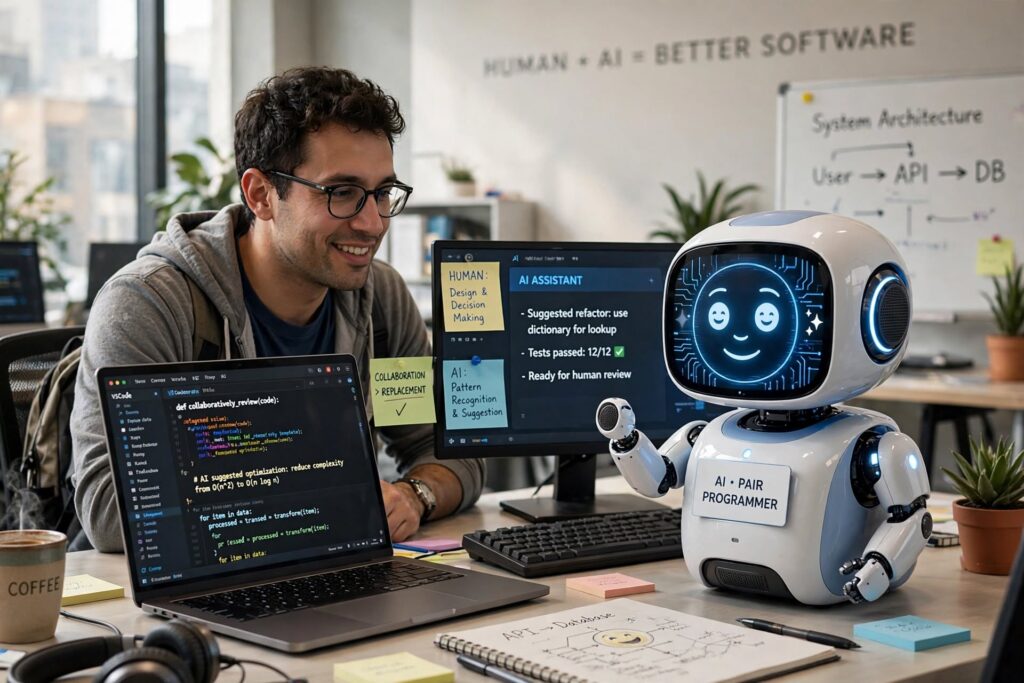
Artificial intelligence is making software development more accessible and changing how technical teams complete their work.
Previously, developers often searched documentation, read programming discussions, wrote code manually, and spent considerable time debugging. AI tools can now help generate code, explain unfamiliar concepts, suggest fixes, and support testing.
However, generating code is only one part of software engineering. A reliable software product still requires people who understand requirements, system design, security, performance, business goals, and the consequences of technical decisions.
In the podcast, Agarwal explained that AI is becoming more widely available to ordinary users and businesses. As a result, its possible applications are expanding beyond specialist technology teams.
He expects AI to have a particularly noticeable effect on repetitive technical tasks, including certain testing activities and routine development work.
Will AI Replace Software Engineers?
AI may automate parts of software engineering, but that does not mean every software engineering role will disappear.
The discussion suggests that companies could increasingly prioritise engineers who can deliver high-quality outcomes with the help of AI rather than simply hiring more people to perform repetitive tasks.
For example, an engineer who understands programming and can use AI tools effectively may be able to build a prototype, investigate bugs, or automate a workflow more efficiently.
At the same time, organisations still need people who can determine whether an AI-generated solution is correct, secure, maintainable, and appropriate for the problem.
The exact effect on employment will depend on the company, the type of work, the quality and cost of AI systems, and the skills available in the market. It is therefore too early to treat any specific prediction about future engineering headcounts as certain.
The practical lesson: Do not compete with AI only on the speed of writing code. Develop the judgment and technical knowledge needed to solve problems that matter.
The Five Most Important Skills for Software Engineers in the AI Jobs Era

During the podcast, Agarwal discussed five skill areas and placed problem-solving first. His suggested order offers a useful starting point for students and working professionals.
1. Problem-Solving Skills
Problem-solving is the ability to understand an issue, identify its cause, evaluate possible solutions, and choose an effective approach.
In software engineering, writing code without understanding the underlying problem can produce a solution that works technically but fails to meet the user’s needs.
For example, imagine that an online store is losing customers during checkout. A developer should not immediately start changing the code. First, they should investigate whether the problem comes from slow loading, confusing design, payment failures, or another issue.
AI can assist with analysing information and suggesting solutions, but engineers must still evaluate those suggestions and make informed decisions.
How to improve this skill:
- Build small projects that solve real problems.
- Practise debugging instead of immediately replacing code.
- Break complex tasks into smaller steps.
- Compare different solutions and understand their trade-offs.
- Ask why a problem exists before deciding how to fix it.
2. Communication Skills
Communication is essential when working with clients, designers, product managers, other developers, and business teams.
An engineer may have excellent technical knowledge but struggle to deliver results if they cannot explain requirements clearly.
Agarwal also highlighted how clear communication can improve the quality of AI-generated output. When a person explains a task poorly, the tool may produce an unsuitable result, requiring repeated corrections.
To use AI effectively, engineers should learn to describe the problem, provide relevant context, define constraints, and explain what a successful result should look like.
How to improve this skill:
- Practise explaining technical concepts in simple language.
- Write clear project requirements and documentation.
- Learn to ask precise questions.
- Share progress and problems with your team.
- Explain your technical decisions and the reasons behind them.
3. Coding Fundamentals
AI-assisted development does not remove the importance of programming fundamentals.
Engineers need to understand variables, functions, data structures, algorithms, databases, APIs, debugging, and software architecture at a level appropriate to their role.
Without this foundation, it becomes difficult to recognise incorrect AI-generated code or determine whether a proposed solution is reliable.
For example, an AI tool may generate a function that appears correct but fails with unusual inputs, creates a security weakness, or performs poorly with large amounts of data. A developer with solid fundamentals is better equipped to identify and fix these problems.
How to improve this skill:
- Learn one programming language thoroughly before jumping between many languages.
- Understand how your code works rather than copying generated answers.
- Write and test functions independently.
- Study debugging and error handling.
- Review AI-generated code before using it in a project.
The goal is not to avoid AI. It is to understand enough about software engineering to use it responsibly.
4. AI Tools and AI-Assisted Development
Agarwal’s advice to engineers was to start experimenting with AI tools instead of assuming they are unimportant.
AI-assisted coding tools can help developers generate code, explore unfamiliar libraries, build prototypes, understand errors, and automate repetitive work.
The important skill is not simply knowing the names of popular tools. It is understanding when to use them, how to guide them, and how to check their output.
Beginners can start with a small project, such as a personal portfolio website, a task tracker, or a simple data dashboard.
Use an AI tool to help plan the project and generate parts of the implementation. Then review the code, test the features, fix errors, and document what you learned.
This approach combines practical building with technical learning.
5. Business Understanding
Software exists to solve problems for users and organisations. Engineers who understand the business purpose of a product can often make better technical decisions.
For example, a company may request a new dashboard. Before building it, a developer should understand who will use it, what decisions it should support, and which information is genuinely necessary.
Business understanding helps engineers prioritise useful features, avoid unnecessary complexity, and communicate more effectively with non-technical teams.
How to improve this skill:
- Learn about the industry your software serves.
- Understand the users and their problems.
- Ask how a feature contributes to a business objective.
- Consider development costs, security, and maintenance.
- Focus on delivering useful outcomes rather than simply completing tasks.
How Students Can Prepare for AI-Powered Software Jobs
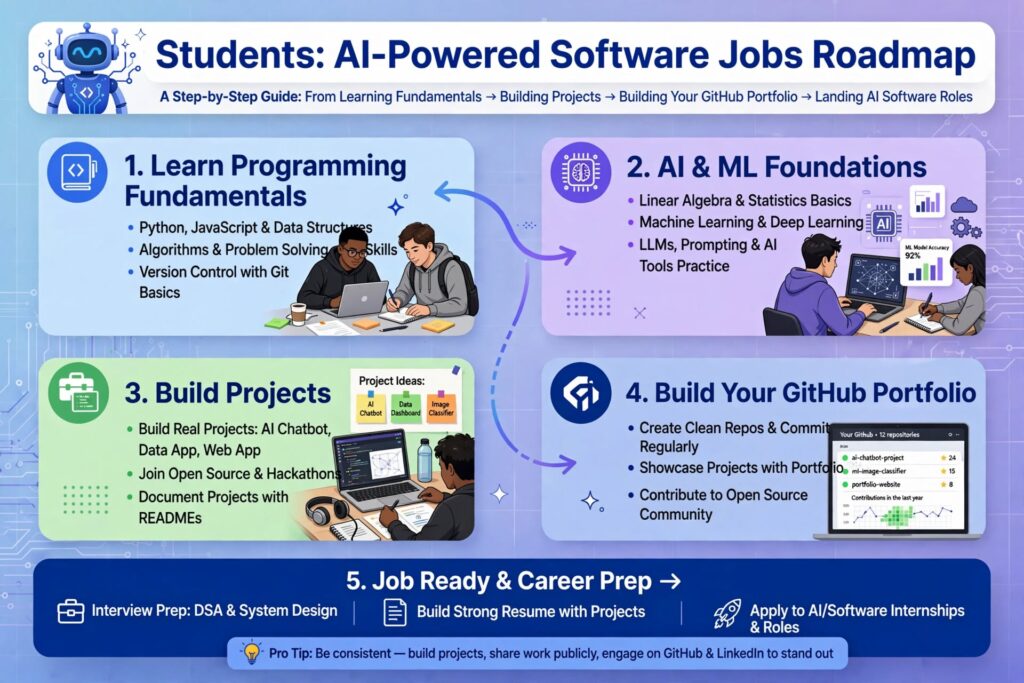
Students pursuing a B.Tech, computer science degree, or another technical qualification should not rely entirely on their university curriculum.
A degree provides an important foundation, but students may also need to develop practical skills that employers expect. The specific gap depends on the university, course, and employer.
In the podcast, Agarwal discussed concerns that some computer science curricula do not change quickly enough to reflect industry requirements. He described working with industry professionals to develop a more practical, AI-oriented learning approach through his education venture.
His broader point is that students benefit when academic learning connects with real projects and current industry practices.
Here is a practical roadmap for students.
Step 1: Learn Programming Fundamentals
Choose a suitable programming language and learn its fundamentals. Python and JavaScript are two possible starting points, depending on your interests and goals.
Do not rush through the basics just to start using AI coding tools.
Step 2: Learn Essential Software Development Concepts
Study data structures, algorithms, databases, APIs, version control, testing, and basic software design.
You do not need to master every advanced topic immediately. Build your knowledge progressively.
Step 3: Start Using AI Tools
Use an AI coding assistant to explore unfamiliar concepts, generate examples, and help debug errors.
Always inspect the output. If you cannot explain what the generated code does, treat that as an opportunity to learn before relying on it.
Step 4: Build Practical Projects
Create two or three projects that demonstrate your skills. Examples include:
- A task management application.
- A website with a database and user authentication.
- A dashboard that analyses a dataset.
- A simple AI-powered application using an appropriate API.
Include a clear explanation of the problem, the technologies used, the challenges you faced, and how you tested the solution.
Step 5: Learn Collaboration and Documentation
Use version control, write project documentation, and practise explaining your work.
These skills help demonstrate that you can contribute to a team rather than only complete isolated coding exercises.
Step 6: Apply and Keep Improving
Apply for internships and entry-level roles when your fundamentals and projects are ready. Review job descriptions to identify the skills employers repeatedly request.
If you receive feedback or discover a skill gap, work on it and continue applying.
There is no guarantee that this process will lead to a job within a particular period, but it gives you a structured way to improve your readiness.
Is Computer Science Too Crowded?
The podcast raises a concern familiar to many students: large numbers of graduates are competing for software and technology jobs.
Agarwal’s perspective was that competition and skill relevance both matter. In his view, employers may still have opportunities for candidates who possess the skills needed for specific roles, even when many graduates are seeking work.
This does not mean that every candidate who learns a few additional tools will automatically find employment. Hiring also depends on the number of vacancies, economic conditions, experience, interview performance, location, and employer requirements.
However, students can take practical steps to improve their position.
Rather than adding a long list of technologies to a résumé, focus on demonstrating useful skills through projects. Learn to explain your decisions, solve problems, and work with existing code.
A portfolio that demonstrates your ability to build and maintain something useful can provide more meaningful evidence of practical ability than a list of tools you have only briefly explored.
Will AI Reduce the Number of Software Engineering Jobs?
One of the most interesting questions in the discussion was whether the work previously handled by ten engineers could eventually be completed by three or four.
Agarwal did not give a definitive number. He suggested that the amount of work performed by a team could change, while noting that the outcome depends partly on the cost and effectiveness of AI tools.
This distinction matters because increased productivity does not automatically translate into a fixed number of job losses.
Companies may use AI to reduce costs, deliver products faster, improve existing services, or develop new products. Some tasks may require fewer people, while new responsibilities and specialist roles may emerge.
The podcast also discussed the possibility of new work related to AI systems and their efficient use, including token optimisation and controlling the cost of AI-powered applications.
These are plausible areas of development, but the size and availability of such opportunities remain uncertain.
For engineers, a sensible response is to prepare for changing responsibilities rather than assume that either widespread job loss or unlimited new jobs is guaranteed.
New Opportunities Emerging Around AI
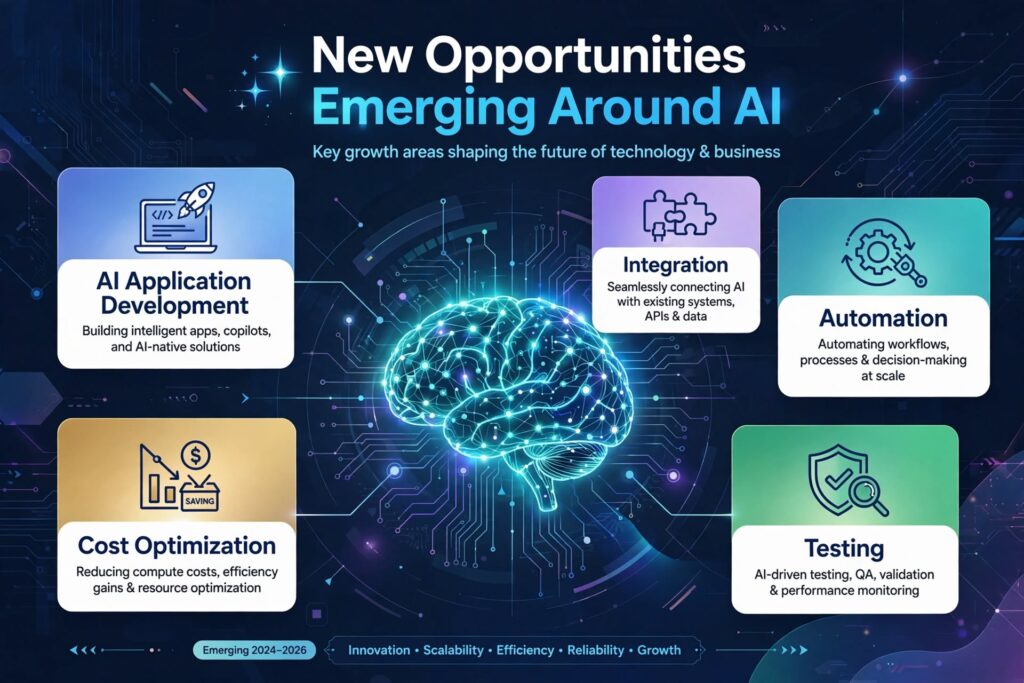
As businesses experiment with AI, several areas may offer opportunities for people with suitable technical and problem-solving skills.
These include:
- AI application development: Building products that use AI models to support specific tasks.
- AI integration: Connecting AI capabilities with existing business software and workflows.
- Automation: Reducing repetitive work through software agents and automated processes.
- AI evaluation and testing: Checking whether AI systems produce accurate, reliable, and safe results.
- AI cost optimisation: Improving how applications use models and manage computational expenses.
- Software development with AI tools: Combining conventional engineering knowledge with AI-assisted workflows.
These are examples of relevant skill areas, not a guarantee that every employer will recruit for each role or that every position is new.
A strong foundation in software development can make it easier to explore these specialisations as your interests and the market evolve.
Why AI Should Be Used With Technical Knowledge
AI tools can produce impressive results, particularly when used to create prototypes or speed up routine development.
However, a working demonstration is not necessarily a production-ready application.
Generated software may contain bugs, insecure patterns, performance problems, or incorrect assumptions. It may also fail to meet the user’s actual requirements.
That is why the combination of AI tools and coding fundamentals is important.
For example, a beginner might use an AI assistant to generate a login system. Before deploying it, the developer should understand authentication, password handling, access control, input validation, and security testing.
The same principle applies to data analysis, website development, and automation.
Use AI to accelerate learning and implementation, but retain responsibility for checking the result.
What Can Engineers Learn From Startup Founders?
Agarwal’s experience at OYO and Spinny also offers lessons beyond software development.
He highlighted several ideas he learned while working closely with founders and startup teams.
Customer Obsession
A business should understand its customers and work to address their needs. In software development, this means listening to users, investigating complaints, and improving the product based on meaningful feedback.
Standardisation at Scale
When a company expands, it needs processes that help maintain a consistent experience. Software engineers can contribute by building reliable systems, documenting workflows, and reducing avoidable errors.
Learning Through Execution
Ideas are important, but execution turns them into something real. A project, business, or product improves when people build it, test it, learn from mistakes, and make adjustments.
Understanding the Bigger Picture
Working with a startup team can expose professionals to decisions beyond their immediate job responsibilities. They may gain experience in product priorities, customer needs, resource allocation, and business growth.
These lessons can be useful even for people who do not intend to become founders.
Founder Mindset: Why Execution Matters More Than Ideas
Many students dream of building a startup. They may have several ideas for apps, websites, or technology products but struggle to take the first step.
Agarwal’s advice was that execution matters. Rather than waiting for the perfect moment, people should assess whether they have the resources and ability to test an idea and then begin working on it.
A practical approach is to:
- Identify a real problem that people experience.
- Speak to potential users and understand their needs.
- Build a small version of the proposed solution.
- Test it and collect feedback.
- Improve the product based on what you learn.
- Evaluate whether the idea has enough potential to continue.
Starting small helps you learn without assuming that your first idea will become a successful business.
Taking action does not mean ignoring financial responsibilities or risking money you cannot afford to lose. Calculated risks and gradual experiments can help you learn while limiting unnecessary exposure.
Why Discipline and Financial Management Matter
Technical knowledge is only one part of long-term professional growth.
Agarwal identified discipline as one of the most important lessons from his twenties. He also emphasised the importance of financial management and looking actively for opportunities.
Discipline helps professionals allocate time to work, learning, health, and personal responsibilities. It is especially useful when trying to learn new skills while working or studying.
Financial management is equally important. Building a budget, tracking expenses, developing savings habits, and understanding financial commitments can help reduce stress and support better career decisions.
Networking also matters. Professional relationships can help people discover opportunities, exchange knowledge, and receive guidance from experienced individuals.
These habits do not guarantee success, but they can create a stronger foundation for handling career changes and uncertainty.
Does Fitness Matter for Software Engineers?
Software engineers often spend long periods sitting at a desk. Maintaining physical health can support general well-being and help make a demanding routine more sustainable.
In the podcast, Agarwal described how he began focusing more seriously on fitness and prepared for Ironman 70.3 events. He connected that experience with discipline, consistency, and planning.
His personal advice was to make time for daily exercise.
The appropriate exercise routine varies from person to person, but the broader lesson is useful: professional development should not require neglecting health.
Building sustainable habits can help you maintain energy and balance throughout your career.
What Should You Do If You Are Already a Software Engineer?
If you are currently working in software development, you do not necessarily need to abandon your existing skills or restart your career.
Instead, assess how AI could improve the work you already do.
Start by identifying repetitive tasks in your workflow. Experiment with AI assistance for code explanations, test generation, debugging, documentation, or prototyping, where appropriate.
Then measure whether the tools genuinely improve your results. Review generated code, follow your organisation’s security and privacy requirements, and avoid placing confidential information into tools that are not approved for that purpose.
You can also strengthen skills that AI does not automatically provide: understanding user requirements, system design, communicating with stakeholders, making trade-offs, and taking responsibility for production systems.
A useful learning plan is to choose one new capability, apply it to a real project, review the results, and repeat the process.
Frequently Asked Questions
1. Will AI replace software engineers in the future?
AI may automate some software development tasks and change the number or type of engineers companies need. However, the overall effect on employment remains uncertain. Engineers can prepare by learning AI tools, strengthening technical fundamentals, and improving problem-solving skills.
2. Which skills are most important for software engineers in 2026?
Based on the podcast discussion, important skills include problem-solving, communication, coding fundamentals, AI tool usage, and business understanding. The exact priorities depend on the role and employer.
3. Should beginners learn coding or AI tools first?
Beginners should build programming fundamentals while learning how AI tools work. These skills complement each other: programming knowledge helps you understand, test, and correct AI-generated code.
4. Can AI tools help students get software engineering jobs?
AI tools can help students learn concepts, build projects, and practise problem-solving. However, using AI tools alone does not guarantee employment. Students also need practical skills, demonstrable projects, interview preparation, and a good understanding of the roles they are applying for.
5. Will AI create new jobs in technology?
AI may create opportunities in application development, integration, automation, testing, and system optimisation. The number and nature of future jobs will depend on how businesses adopt AI and how the technology develops.
6. Is a computer science degree still valuable in the AI era?
A computer science degree can provide useful theoretical and technical foundations. Students should complement their studies with practical projects, industry-relevant tools, and the ability to solve real problems. The value of a particular degree also depends on its quality and the requirements of the job.
7. What is the best way to start learning AI-assisted coding?
Choose a small project and use an AI coding tool to help you plan and implement it. Read the generated code, test it, investigate errors, and learn the concepts behind the solution. Gradually increase the complexity of your projects.
8. What is the most important lesson from Harshit Agarwal’s career journey?
One central lesson is the importance of continuous learning and adaptability. His transition from engineering into business, startups, and education illustrates how people can develop new capabilities and change professional direction over time.
Final Thoughts
The future of software engineering will not be shaped by AI alone. It will also depend on how businesses use technology, what customers need, and how engineers respond to changing expectations.
Harshit Agarwal’s advice in the podcast is to start learning and building with AI instead of dismissing it. At the same time, engineers should preserve the fundamentals that allow them to understand problems, evaluate solutions, and deliver reliable software.
For students, the next step is to build a strong technical foundation and create practical projects. For experienced engineers, it is to explore AI tools, improve productivity, and continue developing skills that support sound technical and business decisions.
You do not need to predict every change in the technology industry to prepare for it. Start with what you can control: learn consistently, build useful things, communicate clearly, and adapt as you gain experience.
The goal is not simply to use AI. It is to become an engineer who knows how to use it effectively and responsibly.